Malaria: Artemisinin resistance emerges now in Africa

Cases of resistance to the anti-malarial drug artemisinin have been identified in Rwanda, the first time this “major public health threat” has been discovered in Africa.


Artemisinin resistance is widespread across South-East Asia, but researchers say that until now it had not been reported in Africa, where 93 per cent of the world’s 228 million malaria cases and 94 per cent of the more than 400,000 deaths occur each year.

Chloroquine was the favoured first-line antimalarial treatment in the 1960s, before resistance developed in the Greater Mekong subregion and spread to Africa. This was followed by resistance to pyrimethamine, used in association with sulfadoxine, says the research team from institutes including the Rwanda Biomedical Centre (RBC), the Pasteur Institute, and the World Health Organization.

Read More>>>

Enhancing global health communication during a crisis: lessons from the COVID-19 pandemic

“The COVID-19 pandemic has introduced unique challenges for public health practitioners and health communicators that warrant an expansion of existing health communication principles to take into consideration: the new infodemic (or mis/disinfodemic) challenge – particularly as treatments and vaccines are being developed; communication of risk and uncertainty; health-information behaviours and the instantaneous nature of social media, and the relationship between media literacy and health literacy; the effects of the pandemic on other health issues; and the need for a flexible communication strategy that adapts to the different stages of the pandemic.”

Lessons learnt: Principles discussed in this article will help build preparedness capacity and offer communication strategies for moving from the acute phase to the ‘next normal’ with likely prevention (e.g. herd immunity achieved through vaccination) and societal COVID-19 resilience.

Conclusion

The COVID-19 crisis has been the first pandemic to be almost ‘livestreamed’ on social media and digital platforms. Drawing on the lessons learnt from this situation and contextualising the new media environment that health communicators are called to operate in, the checklist presented in this paper is intended to be used as a tool for preparation as well as a tool for implementation of communication strategies to move from the acute phase of the pandemic to the ‘next normal’. It is critical that health communicators worldwide are more proactive in tackling risk communication challenges related to COVID-19, with likely prevention achieved through vaccination and societal COVID-19 resilience.

See full article >>>

Published in…

This work was originally published in Public Health Research and Practice, available at https://doi. org/10.17061/phrp3022010

Crop disease pandemic coming ‘sooner rather than later’?

Global trade and monoculture will lead to crop disease pandemics that jeopardise world food systems, experts warn.
A healthy wheat crop in Uganda, just weeks from harvest, turns into a tangle of black stems and shrivelled grains. As much as 80 per cent of the harvest is lost, a fate that destroys the farmer’s investment in the fields and damages the livelihood of the family.

Soon wheat fields in Kenya, Ethiopia and Egypt experience the same fate. Iran follows, along with India, Pakistan and Lebanon. Then countries in Asia and Europe show signs.

The culprit is wheat stem rust. A plant disease that has been known for decades, a virulent new strain, Ug99, emerged in 1999 to ravage wheat production across the globe — and was spread by the wind.” Read More>>>

Wheat stem rust is a fungal disease caused by the Puccinia graminis f. sp. Tritici (Pgt) fungus that can affect wheat, barley, oat, rye and triticale when seasonal conditions are favourable. The fungus survives on host plants and can spread quickly over large distances by wind, movements of infected plant materials and contaminated farm machinery, equipment and clothing.

Wheat stem rust can attack all above-ground parts of the plant, including the stem, leaves and inflorescence. Infected wheat plants may also produce shrivelled grain. An untreated infection could reduce grain yield by up to 90 per cent.

Wheat stem rust is present in many wheat growing areas throughout the world, and around two-thirds of global wheat growing areas are climatically suitable for the disease. Areas vulnerable to stem rust is shown in the Figure above. Read More>>>

Food, Seed and Climate Change Resilience

Seed and food sovereignty is a core part of climate change resilience. Food sovereignty is ‘the right of peoples to healthy and culturally appropriate food produced through ecologically sound and regenerative methods’. Locally grown food provides jobs and livelihoods for local communities. This goes beyond food ‘security’ – it prioritises local and national economies and markets over international trade. Locally grown food provides food jobs and wealth to local economies. Working and growing locally can provide a stable future for future generations.

See the Gaia Foundations projects promoting this and other issues.

More>>>

COVID-19 vaccine showed robust immune responses in Phase I/II trial

Interim results from the ongoing Phase I/II COV001 trial, led by Oxford University, showed AZD1222 was tolerated and generated robust immune responses against the SARS-CoV-2 virus in all evaluated participants.

COV001 is a blinded, multi-centre, randomised controlled Phase I/II trial with 1,077 healthy adult participants, aged 18-55 years. It assessed a single dose of AZD1222 against a comparator meningococcal conjugate vaccine, MenACWY. Ten participants also received two doses of AZD1222 one month apart.

The results published in The Lancet confirmed a single dose of AZD1222 resulted in a four-fold increase in antibodies to the SARS-CoV-2 virus spike protein in 95% of participants one month after injection. In all participants, a T-cell response was induced, peaking by day 14, and maintained two months after injection.

Neutralising activity against SARS-CoV-2 (as assessed by the MNA80 assay) was seen in 91% of participants one month after vaccination and in 100% of participants who received a second dose. The levels of neutralising antibodies seen in participants receiving either one or two doses were in a similar range to those seen in convalescent COVID-19 patients. Strong correlations were observed across neutralisation assays.

The early safety responses confirmed that transient local and systemic reactions were common in the AZD1222 group and were comparable to previous trials and other adenoviral vector vaccines.1-4 They included temporary injection site pain and tenderness, mild-to-moderate headache, fatigue, chills, feverishness, malaise and muscle ache. No serious adverse events were reported with AZD1222, and reactions were lessened with the use of prophylactic paracetamol, a pain killer, and occurred less frequently after a second dose.

Professor Andrew Pollard, Chief investigator of the Oxford Vaccine Trial at Oxford University and co-author of the trial, said: “The interim Phase I/II data for our coronavirus vaccine shows that the vaccine did not lead to any unexpected reactions and had a similar safety profile to previous vaccines of this type. The immune responses observed following vaccination are in line with what we expect will be associated with protection against the SARS-CoV-2 virus, although we must continue with our rigorous clinical trial programme to confirm this. We saw the strongest immune response in participants who received two doses of the vaccine, indicating that this might be a good strategy for vaccination.”

More>>

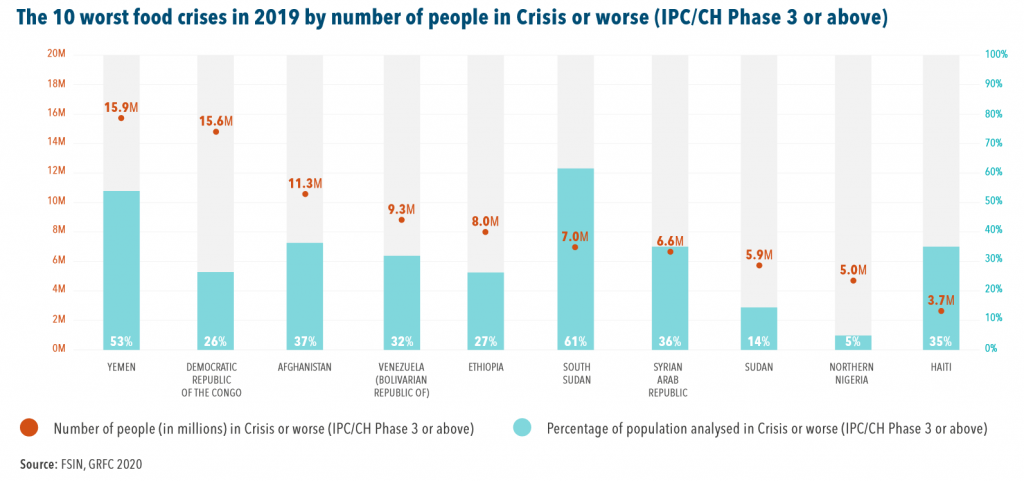
Global Report on Food Crises (GRFC) 2020

The Global Report on Food Crises (GRFC) 2020 is the result of a joint, consensus-based assessment of acute food insecurity situations around the world by 16 partner organizations.At 135 million, the number of people in Crisis or worse (IPC/CH Phase 3 or above) in 2019 was the highest in the four years of the GRFC’s existence. This increase also reflected the inclusion of additional countries and areas within some countries. When comparing the 50 countries that were in both the 2019 and the 2020 reports, the population in Crisis or worse (IPC/CH Phase 3 or above) rose from 112 to 123 million. This reflected worsening acute food insecurity in key conflict-driven crises, notably the Democratic Republic of the Congo and South Sudan and the growing severity of drought and economic shocks as drivers in countries such as Haiti, Pakistan and Zimbabwe. Around 183 million people in 47 countries were classified in Stressed (IPC/CH Phase 2) conditions, at risk of slipping into Crisis or worse (IPC/CH Phase 3 or above) if confronted by an additional shock or stressor.

More>>>

Zero Hunger by 2030 in doubt, UN report warns…

More people are going hungry, an annual study by the United Nations has found. Tens of millions have joined  the ranks of the chronically undernourished over the past five years, and countries around the world continue to struggle with multiple forms of malnutrition.

The latest edition of the State of Food Security and Nutrition in the World estimates that almost 690 million people went hungry in 2019 – up by 10 million from 2018, and by nearly 60 million in five years. High costs and low affordability also mean billions cannot eat healthily or nutritiously. The hungry are most numerous in Asia, but expanding fastest in Africa. Across the planet, the report forecasts, the COVID-19 pandemic could tip over 130 million more people into chronic hunger by the end of 2020. (Flare-ups of acute hunger in the pandemic context may see this number escalate further at times.)The State of Food Security and Nutrition in the World is the most authoritative global study tracking progress towards ending hunger and malnutrition. It is produced jointly by the Food and Agriculture Organization of the United Nations (FAO), the International Fund for Agriculture (IFAD), the United Nations Children’s Fund (UNICEF), the UN World Food Programme (WFP) and the World Health Organization (WHO).

Writing in the foreword, the heads of the five agencies warn that “five years after the world committed to end hunger, food insecurity and all forms of malnutrition, we are still off track to achieve this objective by 2030″.

More>>>

Fresh Ebola outbreak emerges

Scientists fear a new Ebola strain might emerge in the Democratic Republic of Congo (DRC) if two versions of the disease mix together to form a new, potentially deadlier version.

Ebola is a highly contagious infectious disease that has a fatality fate of around 50 per cent. There have been multiple outbreaks across Africa in the past decade.

Ebola Nurse

The DRC government earlier last month (June 2020) declared an end to the eastern outbreak – the tenth in the country – but World Health Organization director-general Tedros Adhanom Ghebreyesus warned there was “still potential for flare-ups” of this strain, calling for rapid response teams to remain in place.

The emergence of the northwestern Ebola virus strain also raises the question of whether Ebola survivors could again contract the disease. Studies suggest survivors develop antibodies that can last 10 years, possibly longer, according to the US Centers for Disease Control and Prevention, but it is not known whether people can become infected with a different species of Ebola virus.

More>>>

Unacceptably High Rates of Malnutrition

Everyone deserves access to healthy, affordable food and quality nutrition care. This access is hindered by deeper inequities that arise from unjust systems and processes that structure everyday living conditions. This year’s Global Nutrition Report uses the concept of nutrition equity to elucidate these inequities and show how they determine opportunities and barriers to attaining healthy diets and lives, leading to unequal nutrition outcomes. We examine the global burden of malnutrition with an equity lens to develop a fuller understanding of nutrition inequalities. In doing this, we pinpoint and prioritise key actions to amplify our efforts and propel progress towards ending malnutrition in all its forms.

The Global Nutrition Report calls for a pro-equity agenda that mainstreams nutrition into food systems and health systems, supported by strong financing and accountability. With only five years left to meet the 2025 global nutrition targets, time is running out. We must focus action where the need is greatest for maximum impact.

More>>>